
Cork or champagne stopper: which one should you use
· Stop Vine
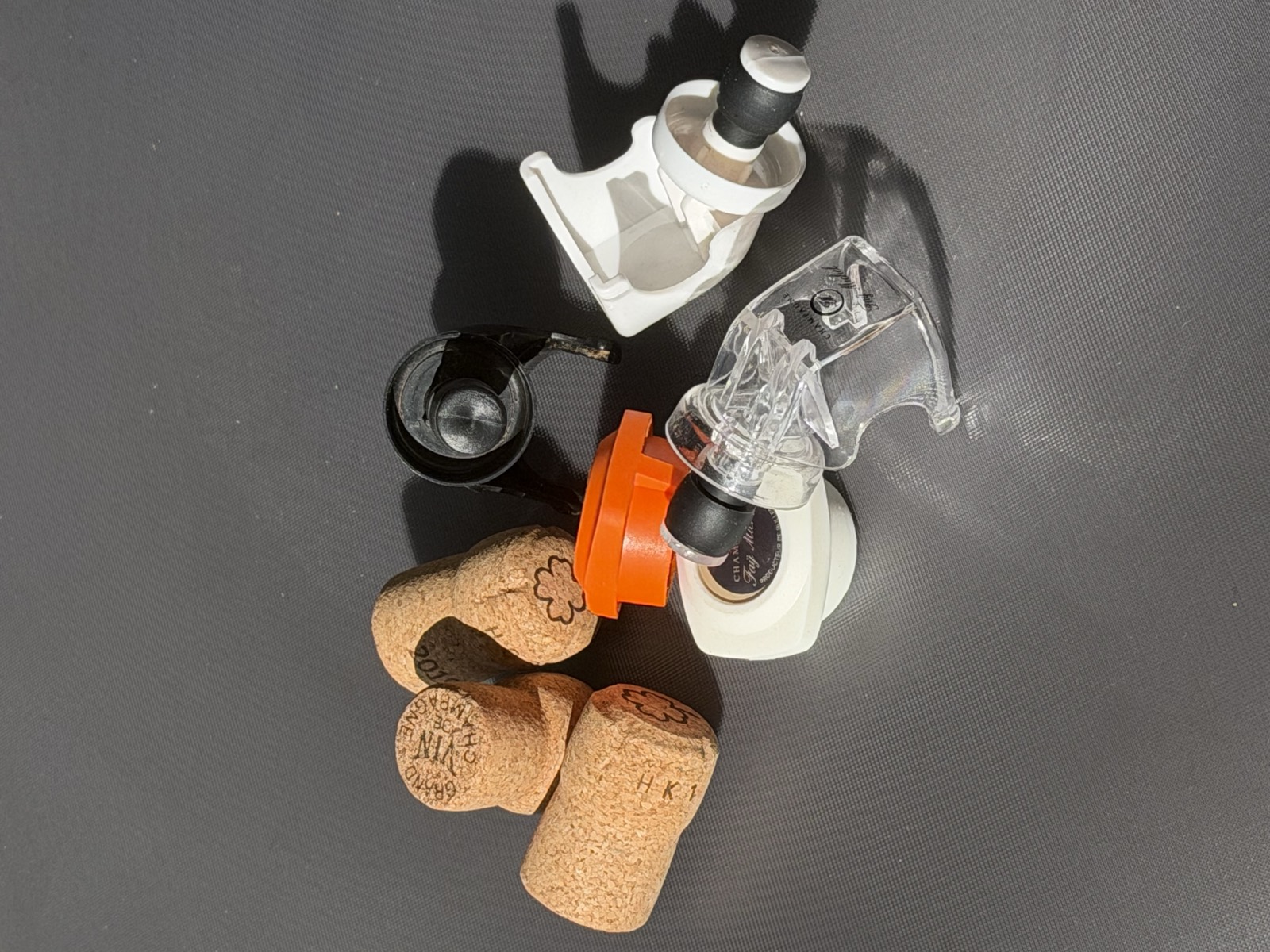
It is the move everyone tries at least once: picking the cork back up off the table and trying to push it into the neck. It will not go in. Ever.
That is not a manufacturing flaw, it is the whole principle of the object. Here is what really separates a cork from a cork stopper, and which one to use in your situation.
Two objects, two opposite jobs
The confusion comes from calling them both “stoppers”. In reality they do completely different work.
The cork seals the bottle before opening. Its mission lasts for years, under considerable pressure, and it ends for good the day you pull it out.
The cork stopper seals the bottle after opening. Its mission starts exactly where the cork’s ends, and it repeats indefinitely.
They are not competitors. They are two halves of the same cycle.
The cork: designed to work only once
A champagne cork is not a simple cylinder. It is a piece of engineering: an agglomerated cork body topped, at the end touching the wine, with two or three discs of natural cork glued in place.
Before bottling it measures around 31 mm in diameter. A machine compresses it by force until it fits into a neck whose internal opening is barely 17 to 18 mm. It goes through brutal compression.
Once in place, it relaxes slowly over months. It hugs the neck at the bottom, stays wide at the top, and takes on that characteristic mushroom silhouette that lets a connoisseur estimate a bottle’s age at a glance.
The day you extract it, it has recovered a diameter far larger than the neck. Putting it back is physically impossible, and a cork forced in crooked provides no seal anyway.
It is a consumable, in the same way a bottle cap is. It has done its job.
Wire cage, cap, foil: what does what
The vocabulary of a champagne bottle neck causes endless confusion. Four distinct elements sit on top of each other.
| Element | Role |
|---|---|
| The foil | The decorative metallic sleeve covering everything |
| The wire cage (muselet) | The wire frame stopping the cork from being ejected |
| The cap plate | The small metal disc under the wire, often illustrated and collected |
| The cork | The cork itself, the only element providing a seal |
The wire cage is not decorative: with close to 6 bars of pressure inside, roughly six times atmospheric pressure, the cork would be launched without it. But it seals nothing by itself. Once the cork is out, cage and cap plate are useless.
The cork stopper: designed for what comes after
The cork stopper answers a problem the cork cannot address: resealing an already opened bottle, repeatedly.
Its principle is mechanical rather than elastic. Two side jaws hook under the lip of the neck, that ring of glass at the top of the bottle. An internal seal provides the airtightness, and the residual gas pressure presses the seal against the glass instead of blowing the device off.
That is why it clamps onto the external diameter of the neck, standardised at 29 mm on champagne, crémant and prosecco bottles, rather than inside the opening like a cork.
The result: an opened bottle keeps a clear effervescence for three to five days in the fridge, instead of a few hours.
The direct comparison
| Cork | Cork stopper | |
|---|---|---|
| When it is used | Before opening | After opening |
| Reusable | No, never | Yes, indefinitely |
| Principle | Compression of the material | Mechanical clamping under the lip |
| Lifespan | A single bottle | Years |
| Preservation after opening | None | 3 to 5 days |
| Customisable | Hot branding, expensive | Logo printing, often included |
The false solutions to rule out
Three habits circulate, none of them hold up.
Forcing the cork back in. At best you tear it, at worst you leave pieces in the wine. And the seal is still non existent.
Cling film and a rubber band. It holds back fridge odours, not pressure. The gas escapes in under a day.
The spoon in the neck. It acts on neither pressure nor temperature, the only two factors that retain carbon dioxide. We covered exactly why in our article on keeping the bubbles after opening.
Which one to choose, depending on your use
At home, the question barely arises: the cork is imposed by the producer, the stopper is a comfort purchase. One is enough for the whole household.
For a wine merchant or a restaurant, it is an economic issue. Serving champagne by the glass means keeping an opened bottle without losing the next day’s service. Without a reliable stopper, every bottle opened late in service is a straight loss.
For a producer, the interest is different and often underestimated. The cork carries your name but ends up in a drawer or the bin. The stopper stays on the customer’s worktop and comes back out for every bottle of sparkling wine, including your competitors’ bottles.
The object the customer keeps
This is where the maths gets interesting for an estate.
A custom branded cork is expensive to mark and disappears after a single use. A cork stopper carrying your logo costs around €1 per unit, marking included, and works for your brand for years.
Given after a cellar visit or an order, it plants your name in the customer’s daily life. Sold in your shop between €5 and €12, it also generates a comfortable margin.
We detail the selection criteria, certifications and pricing in our complete guide to the custom champagne cork stopper.
Frequently asked questions
Can you put the original champagne cork back in? No. Compressed at bottling, it then expands inside the neck and recovers a far larger diameter. Putting it back is physically impossible.
What is the difference between a cork and a cork stopper? The cork seals the bottle before opening and works only once. The stopper reseals it after opening and is reused indefinitely.
What is the wire cage for? The wire frame stops the cork being ejected by the 6 bars of pressure. It seals nothing by itself.
Does a cork stopper fit every bottle? Every standard format bottle, meaning a neck with an external diameter of 29 mm: champagne, crémant, prosecco, cava.
Can cork be recycled? Yes. Many schemes collect corks to turn them into insulation or objects, often to benefit charities.
How long does a cork stopper last? Several years if it is well made. The seal wears out before the mechanism does.
In summary
The cork and the cork stopper are not rivals, they follow one another. The first protects the wine until opening, then its mission ends. The second takes over and preserves the effervescence for several days.
At home it is a comfort. For a wine merchant or restaurant it is a direct saving. For a producer it is a brand object that keeps working long after the sale.
Looking for reliable cork stoppers, customisable with your logo? Discover the SPARK 3 on our homepage, from €1 per unit with marking included.