
How to keep champagne bubbles after opening
· Stop Vine
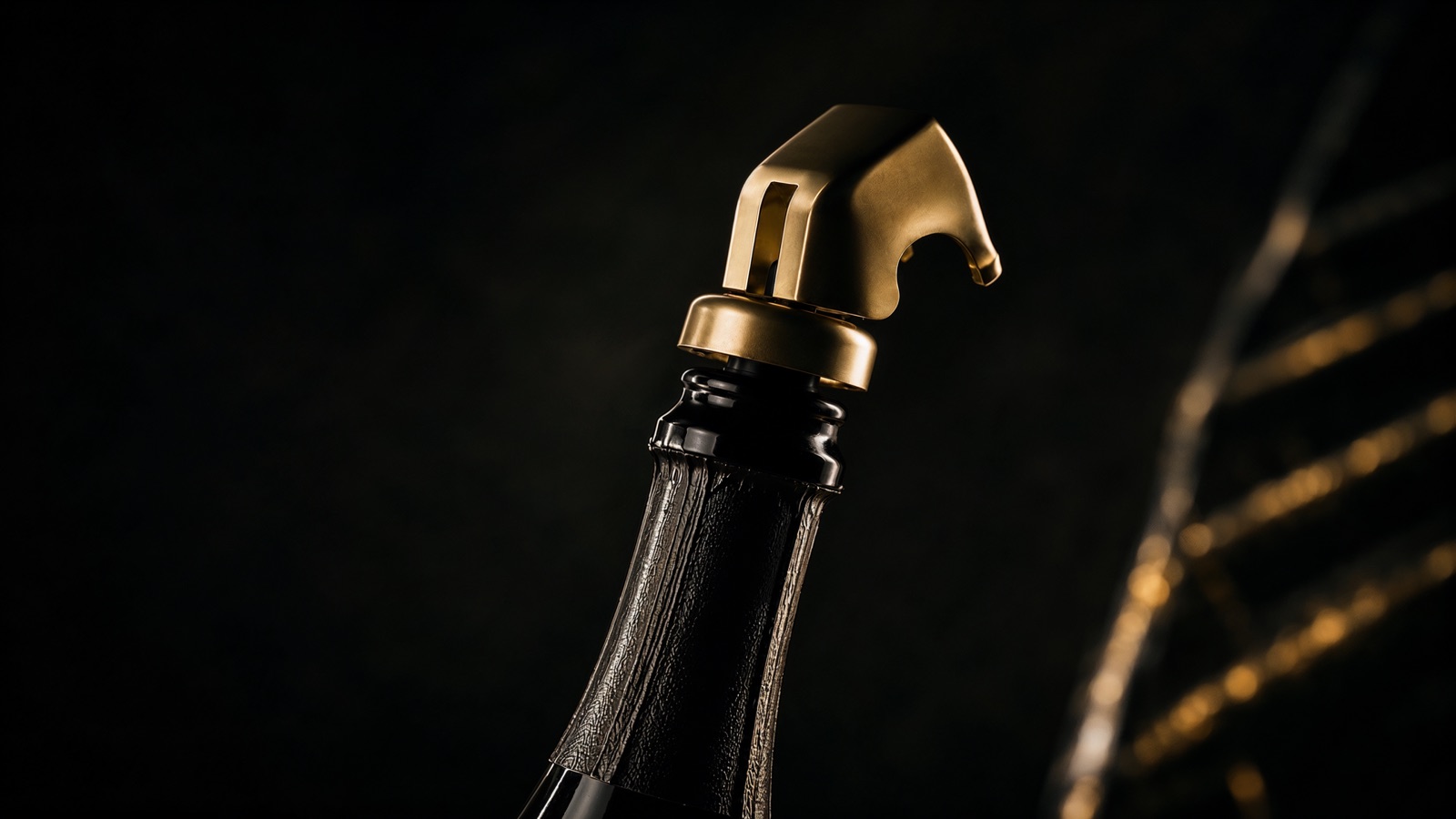
You open a beautiful bottle, you pour three glasses, and the next day all that is left is a flat, sad wine. It is the most common frustration around champagne, and it rests on a series of beliefs that do not survive contact with the facts.
Here is what actually works, what does not, and why.
The spoon in the bottle neck does not work
Let us start with the most widespread one. The belief holds that a silver spoon slipped handle down into the neck preserves the effervescence.
It is false, and the explanation is simple. Carbon dioxide escapes from a liquid according to pressure and temperature, not according to the presence of a metal object hanging several centimetres above the surface of the wine. A suspended spoon changes neither. It creates no barrier, no seal, no cold plug.
Tests run by the champagne industry compared opened bottles with and without a spoon: no measurable difference.
So why do so many people swear by it? Because the bottle with the spoon spends the night in the fridge. And cold really does work. The credit goes to the refrigerator, not to the cutlery.
Why champagne loses its bubbles
A sealed bottle holds around 5 to 6 bars of pressure, close to six times atmospheric pressure. The carbon dioxide is dissolved in the wine, held in solution by that pressure.
The moment you open it, the pressure drops to that of the surrounding air. The dissolved CO2 has no reason to stay in the liquid: it rises, forms the bubbles, and escapes. The process is continuous and irreversible.
Two levers slow it down, and only two:
- Temperature. The colder a liquid, the more dissolved gas it retains. That is a law of physics, not a trick.
- Pressure in the neck. By resealing airtight, the small amount of CO2 that escapes stays trapped above the wine and slightly raises the pressure, which slows the loss of the rest.
Anything that does not act on those two parameters has no effect.
How long does champagne keep its bubbles
It depends entirely on how the bottle is closed again.
| Method | Effervescence preserved |
|---|---|
| Bottle left open | a few hours |
| Cling film and a rubber band | less than a day |
| Spoon in the neck | no effect |
| Airtight cork stopper, kept cold | 3 to 5 days |
A champagne properly resealed and kept in the fridge stays enjoyable for several days. It will lose a little of its initial liveliness, but it will keep a clear effervescence and an intact nose.
What actually works
Reseal immediately
Every minute matters more than the total duration. Most of the gas escapes in the moments right after pouring. Reseal as soon as you have finished serving, not at the end of the meal.
Keep the bottle cold
Between 4 and 8 degrees. The fridge is your best ally and by far the most effective factor after airtightness. Never leave an opened bottle at room temperature.
Use an airtight cork stopper
It is the only device designed for this. Two side jaws hook under the bottle lip, and an internal seal provides the airtightness. The gas stays trapped, the pressure stabilises, and the bubbles hold for several days.
Be careful though: they are not all equal. A poorly designed model lets the pressure escape overnight. A good stopper must hold without play on a standard 29 mm neck and keep a clear effervescence for at least three to five days.
Leave the bottle upright
Unlike a sealed bottle that you lay down to keep the cork moist, an opened bottle should be stored upright. That keeps the contact surface between the wine and the trapped air in the neck to a minimum.
Why the original cork will not go back in
Many try, nobody succeeds. A champagne cork is compressed at bottling, then gradually expands inside the neck to take its mushroom shape.
Once pulled, it has recovered a diameter far larger than the neck. Putting it back is physically impossible without mangling it, and a forced cork provides no airtightness anyway.
That is precisely the gap the cork stopper fills: it is the only system genuinely designed to reseal a bottle of sparkling wine.
The stakes are even higher for professionals
What is a mild annoyance at home becomes a direct cost in a professional setting.
A restaurant serving champagne by the glass needs to keep an opened bottle without losing the next day’s service. A wine merchant running tastings opens several references a day. An estate welcoming visitors in its cellar opens and recloses constantly.
In all three cases, a reliable stopper turns wasted bottles into served bottles. And when it carries the estate’s logo, it also becomes a brand object the customer takes home.
That is the double benefit we detail in our complete guide to the custom champagne cork stopper: preserving the product and keeping the brand alive.
Frequently asked questions
Does the spoon trick really work? No. It acts on neither pressure nor temperature, the only two factors that retain the gas. The observed effect comes from putting the bottle in the fridge.
How long does an opened champagne keep? A few hours with nothing. Three to five days with an airtight cork stopper and cold storage.
Can you put the original cork back? No. It expands after extraction and can no longer enter the neck, nor provide any seal.
Should an opened bottle be laid down? No, keep it upright. That limits the exchange surface between the wine and the air left in the neck.
At what temperature should an opened champagne be kept? Between 4 and 8 degrees. Cold clearly slows the escape of carbon dioxide.
Is a flat champagne wasted? It is no longer pleasant to drink as is, but it remains usable in cooking, for a risotto or a sauce.
In summary
Forget the spoon. To keep the bubbles in an opened champagne, three actions are enough: reseal straight away with an airtight stopper, keep the bottle upright, and store it in the fridge between 4 and 8 degrees.
With those three reflexes, an opened bottle stays lively for three to five days instead of a few hours.
Are you a producer, wine merchant or restaurateur looking for reliable cork stoppers, customisable with your logo? Discover the SPARK 3 on our homepage, from €1 per unit with marking included.