
Custom champagne cork stopper: the complete guide for producers
· Stop Vine
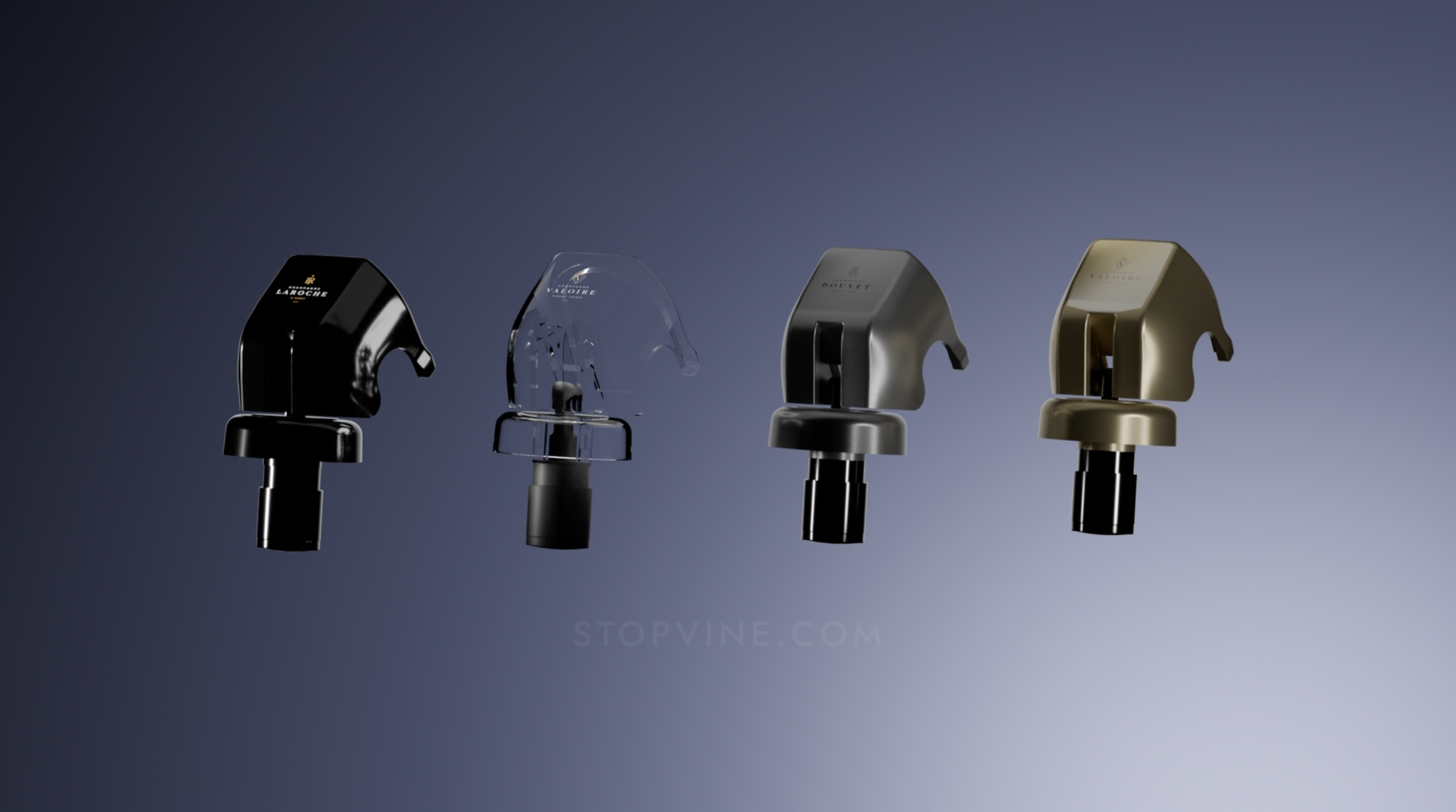
An opened bottle of champagne loses its bubbles within hours. Every producer knows the problem, and most of them are missing the commercial opportunity hidden behind it.
The cork stopper answers both. It preserves the effervescence for several days and, when it carries your logo, it keeps your brand alive long after the sale. This guide brings together everything a wine grower, a cooperative or a champagne house should know before ordering.
What is a cork stopper
A cork stopper is a reusable closure that clamps onto the neck of a sparkling wine bottle after opening. Two side jaws hook under the bottle lip, and an internal seal provides the airtightness.
The result: the carbon dioxide pressure is held, and the bubbles keep for several days in the fridge.
That is the whole difference with the original cork. Once pulled, it swells and becomes impossible to put back. The cork stopper, on the other hand, can be reused indefinitely.
Not to be confused with the wire cage (muselet) that holds the original cork before opening, nor with the cork itself.
A competitive advantage, not just an accessory
This is the point most producers underestimate. The cork stopper is not a packaging expense: it is one of the few items from your estate that keeps working for you after the sale.
It builds loyalty where other media disappear
A label goes in the bin with the bottle. A gift box ends up in the recycling. A business card gets lost. The cork stopper stays in the kitchen drawer and comes back out for every bottle of sparkling wine, including your competitors’ bottles.
Given as a keepsake after a cellar visit, a tasting or an order, it plants your name in the customer’s daily life. When the time comes to buy again, your estate is the first that springs to mind, simply because your logo has been in front of them for months.
Free advertising that travels
A custom cork stopper gets noticed. It sits on the table, among the guests, every time a bottle is opened: family meals, birthdays, end of year celebrations.
Every customer you equip becomes a point of contact with your brand, in a pleasant moment and without any sales pitch. That is exactly the setting where a recommendation happens naturally, when someone asks where that stopper came from.
Set against the cost, the equation is hard to beat: at around €1 per unit, you are buying several years of visibility with a customer you have already won. No other marketing item in the industry offers that lifespan at that price.
A differentiator against neighbouring estates
In a market where cuvées look alike on the shelf, the gesture makes the difference. The customer who leaves with a stopper bearing your name remembers an estate that looks after its customers, not just its bottles.
As long as your neighbours do not offer one, you are the one giving something extra. When they catch up, not having one will become a gap.
And a profitable resale product
Beyond the gift, many estates simply sell them in their shop, between €5 and €12. The margin is comfortable, the item sells itself, and every unit sold keeps carrying your brand.
The technical criteria to check
Not all cork stoppers are equal. Here is what to look at before signing a quote.
Bottle neck diameter
The standard for champagne, crémant and prosecco bottles is 29 mm. A stopper advertised as compatible with the “standard” format must hold on that diameter without play. If your bottler uses an unusual format, ask for a sample before ordering in volume.
Material and certifications
The stopper comes into contact with the wine. Two requirements are non negotiable in Europe:
- European regulation 1935/2004 on materials intended for food contact, evidenced by the CE marking.
- FDA approval if you export to the United States. Without it, your American distributor can refuse the batch.
A food-grade ABS ticks both boxes. Ask for the documents, not just a claim on the supplier’s website.
Actual airtightness
This is the point nobody tests before the goods arrive. A poorly designed stopper lets the pressure escape overnight. Ask for a sample, open a bottle, close it again, and check after 48 hours. A good stopper keeps clear effervescence for at least three to five days.
Assembly quality
Cork stoppers are made of several parts. Hand assembly with unit inspection avoids badly crimped jaws or off-centre seals, which account for nearly all returns.
Customisation: what to negotiate
This is where price gaps between suppliers open up, and where the unpleasant surprises hide.
Logo printing. The most common and most durable technique is direct printing on the flat part of the stopper. Check how it holds over time: marking that fades in the dishwasher ruins the whole point.
Setup and artwork fees. Many suppliers charge for preparing the file, between €50 and €150, sometimes on every new order. This line is negotiable and should be free.
Number of colours. A single colour logo works everywhere. A four colour logo may incur a surcharge depending on the process. Prepare a simplified version of your logo, it often reads better on a small surface.
Available finishes. Gold, black, clear crystal, champagne: the finish should match your packaging. Clear crystal shows off light logos, black gives a more contemporary result.
How much does a custom champagne stopper cost
The price depends almost entirely on the volume ordered. Here is the order of magnitude on the market, marking included.
| Quantity | Indicative unit price |
|---|---|
| 500 | around €1.95 |
| 1,000 | around €1.79 |
| 3,000 | around €1.65 |
| 5,000 | around €1.55 |
| 10,000 | around €1.25 |
| 25,000 and above | around €1.00 |
Two reference points. Below 500 pieces, you enter the per unit promotional goods market, where prices climb fast. Above €3 per unit for a standard ABS stopper, you are mostly paying middlemen.
Our savings calculator gives you an immediate estimate based on your annual volume.
The mistakes that cost money
Ordering without a sample. A photo tells you nothing about airtightness or how your logo will actually look. Any serious supplier sends one.
Overlooking certifications. One quality check at a distributor, and a non compliant batch becomes unsellable. The cost of a recall far exceeds the saving.
Underestimating lead times. Production starts after the proof is approved. If you are targeting the end of year season, place the order in September at the latest.
Ordering too tightly. The unit price drops sharply with volume. Going from 1,000 to 3,000 pieces often costs barely more in total, for three times the stock.
In summary
A good custom cork stopper meets five conditions: 29 mm compatibility, CE and FDA certifications, airtightness verified over several days, durable marking with no setup fee, and a price aligned with your estate’s real volume.
Meet those five criteria and you are not buying an accessory: you are equipping every customer with a permanent reminder of your estate, for about €1 and for several years.
If you would like a costed proposal for your volumes, our team replies the same day. Full SPARK 3 specifications and answers to the most common questions are on our homepage.